
Resource
WordPress vs Laravel: Which Is Better for Your Business Website?
WordPress and Laravel can both be useful, but the better choice depends on whether you need a content website, custom workflow, portal, dashboard, or long-term system.
{"id":3,"parent_id":null,"name":"Laravel Systems","slug":"laravel-systems","type":"post","description":"Guides for custom Laravel portals, dashboards, school systems, membership systems, and workflow software.","seo":{"title":"Laravel Systems | Web Unbounded Blog","description":"Guides for custom Laravel portals, dashboards, school systems, membership systems, and workflow software."},"status":"published","is_featured":true,"is_indexable":true,"sort_order":3,"published_at":"2026-05-03T05:04:54.000000Z","created_at":"2026-05-21T03:43:50.000000Z","updated_at":"2026-05-21T05:04:54.000000Z","deleted_at":null}
7 min read
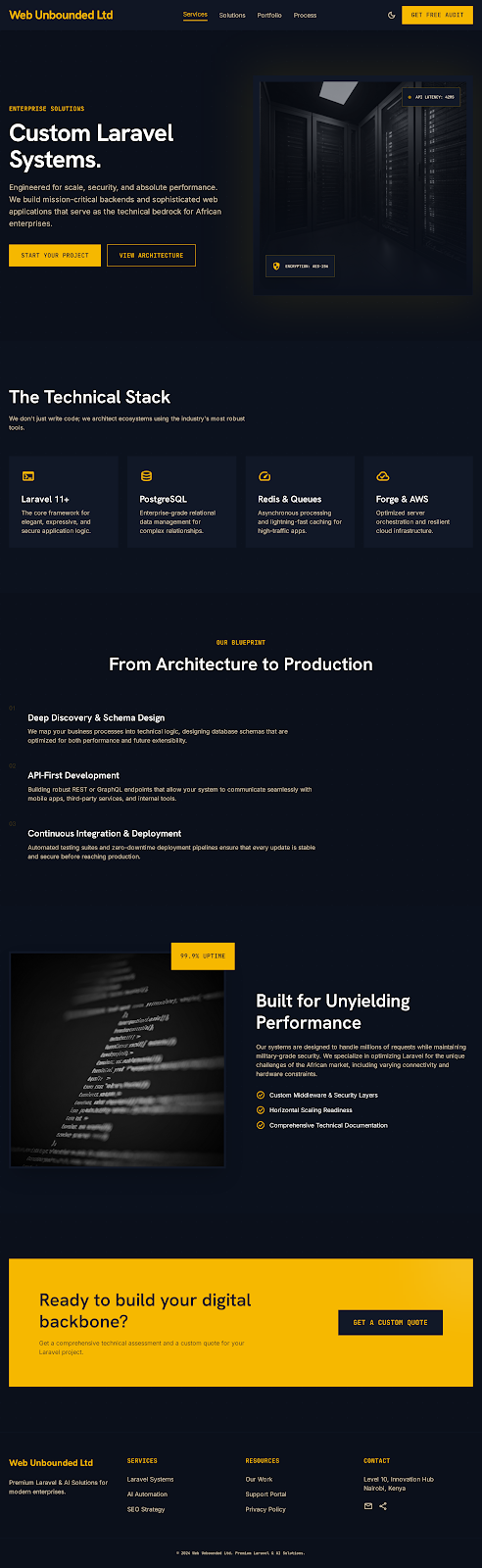
<p>WordPress and Laravel are not direct enemies. They solve different problems well. WordPress is often useful for content-heavy websites with straightforward editing needs. Laravel is usually better when the website becomes a business system.</p>
<p>The right choice depends on what the business needs to control: pages, products, members, records, approvals, reports, payments, integrations, or internal workflows.</p>
<h2>When WordPress makes sense</h2>
<p>WordPress can work for a simple marketing website, blog, or brochure site when the content structure is standard and the plugin stack is controlled. It can be faster to launch when the scope is narrow.</p>
<h2>When Laravel makes sense</h2>
<p>Laravel makes sense when the business needs custom dashboards, roles, secure portals, school systems, membership areas, approval workflows, APIs, reports, or a CMS shaped around the business process.</p>
<h2>The hidden risk is plugin dependence</h2>
<p>Many WordPress sites become fragile because too much business logic lives inside unrelated plugins. Updates become risky, performance drops, and the business cannot easily change the workflow.</p>
<h2>Use the business workflow as the deciding factor</h2>
<p>If the project is mostly pages and articles, WordPress can be enough. If the project needs structured operations, Laravel gives more control and a cleaner long-term foundation.</p>
<p>The right choice depends on what the business needs to control: pages, products, members, records, approvals, reports, payments, integrations, or internal workflows.</p>
<h2>When WordPress makes sense</h2>
<p>WordPress can work for a simple marketing website, blog, or brochure site when the content structure is standard and the plugin stack is controlled. It can be faster to launch when the scope is narrow.</p>
<h2>When Laravel makes sense</h2>
<p>Laravel makes sense when the business needs custom dashboards, roles, secure portals, school systems, membership areas, approval workflows, APIs, reports, or a CMS shaped around the business process.</p>
<h2>The hidden risk is plugin dependence</h2>
<p>Many WordPress sites become fragile because too much business logic lives inside unrelated plugins. Updates become risky, performance drops, and the business cannot easily change the workflow.</p>
<h2>Use the business workflow as the deciding factor</h2>
<p>If the project is mostly pages and articles, WordPress can be enough. If the project needs structured operations, Laravel gives more control and a cleaner long-term foundation.</p>
Common Questions
Short answers for Kenyan businesses planning this decision.
Is Laravel always better than WordPress?
No. Laravel is better for custom systems, while WordPress can be fine for simpler content websites with a controlled plugin setup.
Can I migrate from WordPress to Laravel later?
Yes. A migration should preserve important URLs, content, metadata, redirects, and business-critical workflows.
Which option is better for SEO?
Both can support SEO. The bigger difference is content structure, speed, technical quality, and whether the system stays maintainable.